
Founder Notes
Why I’m Building Small AI Products Instead of Waiting for the Perfect Startup Idea
Nazar Kuzenko
Founder & Mobile Product Engineer at Sych-Tech
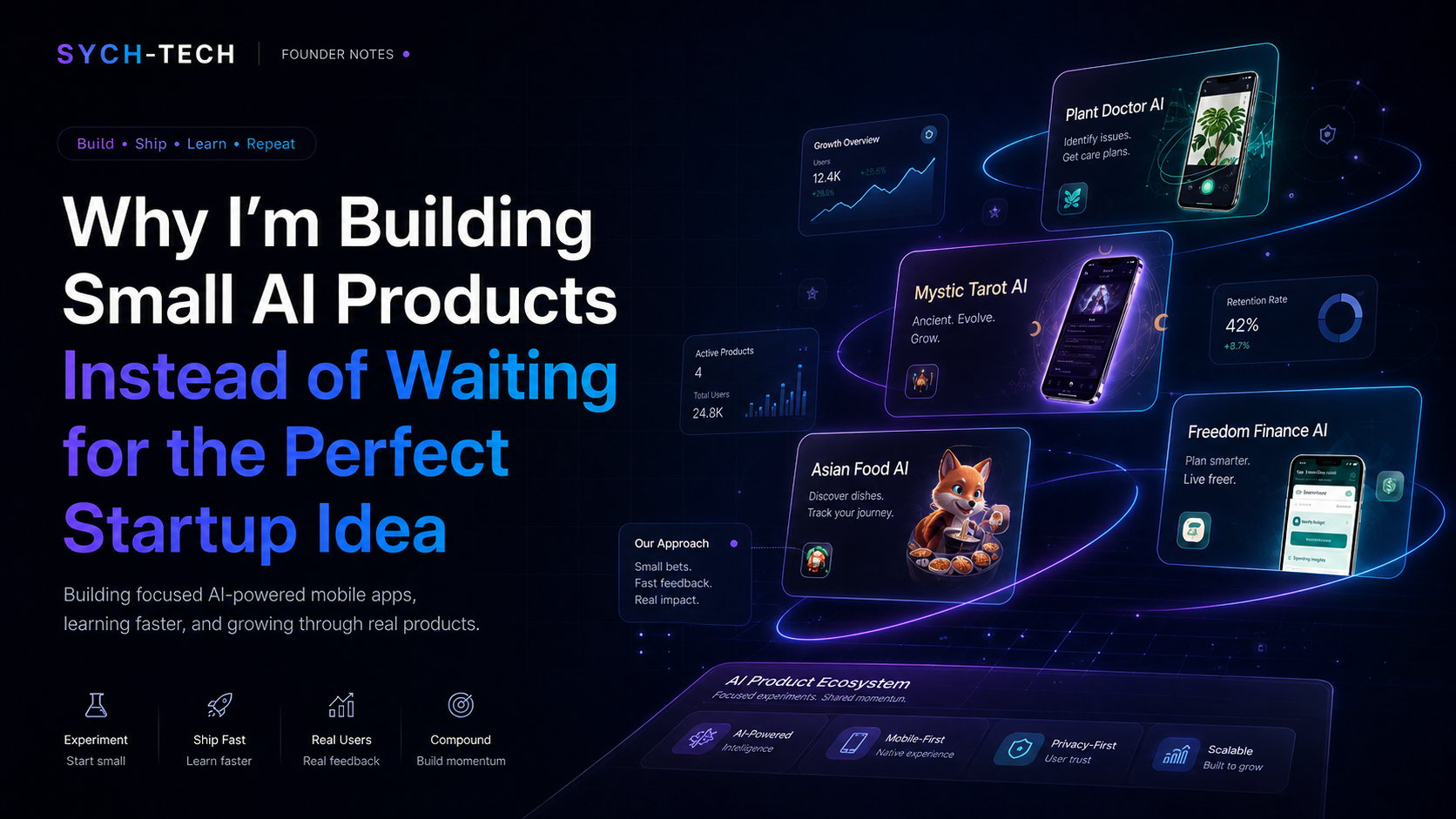
For a long time, I had this idea in my head that if I ever wanted to build something serious, I needed to find the perfect startup idea first.
Something big.
Something unique.
Something that would instantly make sense as “the one.”
And because of that, it is very easy to get stuck.
You keep thinking. You compare markets. You look at competitors. You open app stores, check charts, read posts, watch videos, and tell yourself that you are researching.
And sometimes you are.
But sometimes, honestly, you are just waiting.
Waiting until the idea feels safe enough.
Waiting until the market looks obvious enough.
Waiting until the product feels big enough to justify starting.
The problem is that real products usually do not become clear while they are still only ideas.
They become clear when someone actually uses them.
That is one of the reasons I started building small AI-powered mobile products instead of waiting for one perfect startup idea.
Not because small products are effortless. They are not.
Even a simple app still needs a lot of work: product thinking, design, mobile development, AI integration, store assets, App Store and Google Play review, ASO, analytics, monetization, and updates after launch.
But small products give me something very important:
They let me move.
And movement matters.
When a product is small and focused, it forces you to be honest. You cannot hide behind a huge roadmap or a giant vision deck. You have to answer simple questions:
What problem does this solve?
Who is it for?
Why would someone open it again?
Is AI actually useful here, or am I just adding AI because it sounds good?
Can I explain this product in one sentence?
That last one is especially important.
I think many AI products fail not because the technology is bad, but because the product is too vague.
“AI assistant” can mean anything.
And if something can mean anything, sometimes it means nothing to the user.
Most people do not wake up thinking, “I need an AI assistant.”
They think about specific problems.
My plant looks unhealthy.
I need to organize pet care.
I want to understand my spending.
I want help planning debt payoff.
I want a more structured way to reflect on something.
That is the kind of product I am interested in building.
Not AI for the sake of AI.
Not another generic chat screen.
But focused mobile products where AI helps with a specific job.
This is how I started thinking about Sych-Tech.
For me, Sych-Tech is not a big company pretending to be bigger than it is.
It is my place to build, test, launch, and document real products.
Some of them may stay small.
Some may fail.
Some may need better positioning.
Some may show real potential and become worth improving seriously.
And that is okay.
The goal is not to pretend that every idea is brilliant from day one.
The goal is to create a process where I can learn from reality instead of endlessly guessing.
Every small product teaches something.
Sometimes it teaches that the idea is not strong enough.
Sometimes it teaches that the app is useful, but the store positioning is weak.
Sometimes it teaches that users understand the feature, but not the value.
Sometimes it teaches that the niche is competitive, but still interesting.
Sometimes it teaches that the first version was only the beginning.
This kind of feedback is hard to get from planning alone.
You only see it when people install the app, open it, leave, return, pay, ignore the paywall, uninstall, or send feedback.
That is why shipping matters so much to me.
A shipped product gives you signals.
An idea gives you assumptions.
And assumptions can feel very comfortable when they are never tested.
I also like building small products because I enjoy the whole cycle, not just the coding part.
I like taking an idea and turning it into a real app.
I like thinking about the first screen.
I like deciding what should be in the MVP and what should wait.
I like building the mobile architecture.
I like preparing the store listing.
I like working on screenshots, descriptions, ASO, analytics, and monetization.
I like seeing what happens after release.
That full cycle is what makes it interesting.
Because the app is not only the code.
The product is also the positioning.
The onboarding.
The screenshots.
The pricing.
The trust.
The way the store reviewer understands it.
The way a user explains it to themselves in the first few seconds.
This is something I keep learning with every launch.
And honestly, I would rather learn this by building real things than spend years waiting for a perfect idea that may never arrive.
I am not against big ideas.
I just think big ideas often become clearer after small experiments.
A small app can show demand.
A small launch can reveal a niche.
A small win can create confidence.
A small product can become the first step toward something much larger.
Small does not mean meaningless.
Small can mean focused.
Small can mean fast.
Small can mean practical.
Small can mean close to the user.
That is the mindset I want to build around Sych-Tech.
I want to keep creating focused AI-powered mobile products, learn from each launch, improve what works, and be honest about what does not.
Not every product will become big.
But every real product can teach something.
And right now, that feels much more valuable than waiting for the perfect startup idea.
Because perfect ideas are easy to imagine.
Real products are harder.
But real products move you forward.
One launch at a time.
Apps
Explore the products
Build Notes cover how these apps are made — open a product page for store links, features, and FAQs.
- Plant Doctor AI: Plant Care
- Mystic Tarot AI

- Asian Food AI: Scan & Explore

- Freedom Finance AI: Debt Plan
- Pet Care AI: Smart Companion

- Zodiac AI Chat: Daily Horoscope
Follow the build process or start a conversation about your mobile product.